


With the application of RFID technology in the library, the library has implemented an open self-service borrowing mode, which is convenient for collection management and readers to borrow books. The introduction of RFID technology saves a lot of borrowing procedures. It not only saves time and labor costs, but also starts a new mode of self-service borrowing. However, when the mode of self-service borrowing is turned on, the hidden danger of library book theft is also greatly increased, so how can we ensure the safety of books?
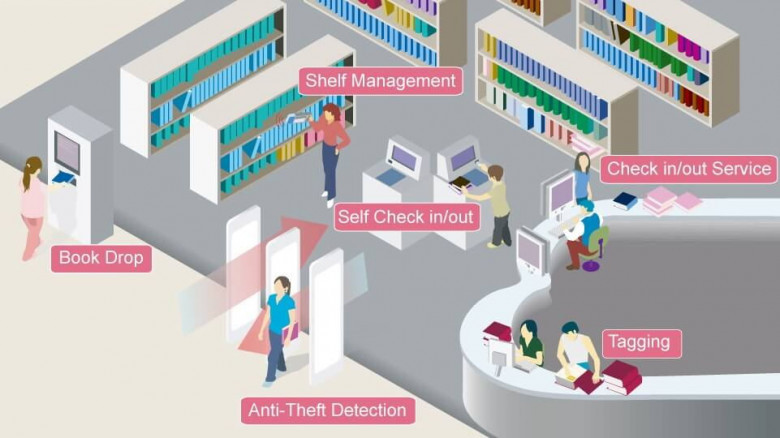
RFID radio frequency identification is a non-contact automatic identification technology. It automatically identifies the target object and obtains relevant data through radio frequency signals, and can quickly track items and exchange data. Its identification does not require manual intervention. As a new technology, RFID is not just a simple substitute for magnetic stripe code. Its application has made the development of libraries enter a new milestone, and user service and experience have been further strengthened. Its advantage lies in
1. Realize self-service borrowing. With the combination of library security door, RFID electronic tag(click here) and self-service borrowing and returning machine, RFID readers(more info) can realize self-service borrowing without librarians from entering to leaving the library
2. Improve the efficiency of borrowing and returning books. The fast anti-collision processing algorithm of RFID technology can read and identify multiple books at the same time. Readers can mainly use the self-service borrowing and returning machine to avoid the phenomenon of waiting in line, thus improving the borrowing and returning efficiency
3. Strengthen anti-theft detection capability
Different from the traditional magnetic stripe anti-theft system, the traditional one often has many non real theft situations, such as false alarm, five alarms due to unclean degaussing, etc. The RFID high-frequency safety door adopts three-dimensional induction technology, which can quickly sense the electronic tag in any direction in the three-dimensional space in the induction area. If the book without borrowing record passes through the safety door, the safety door will send an audible and visual alarm, thereby reducing the theft rate of books
The functional advantage of RFID anti-theft safety door lies in
1. It can detect one or more RFID tags at the same time to reduce the theft rate of books
2. No need for too many security personnel, reduce labor costs and improve the borrowing environment
3. Support the two-way statistics of the number of people entering and leaving the library, so that the library administrator can understand the flow of people in the library
4. It supports online and offline working modes, which are stable and reliable, easy to use, and can be used continuously for 24 hours.


