


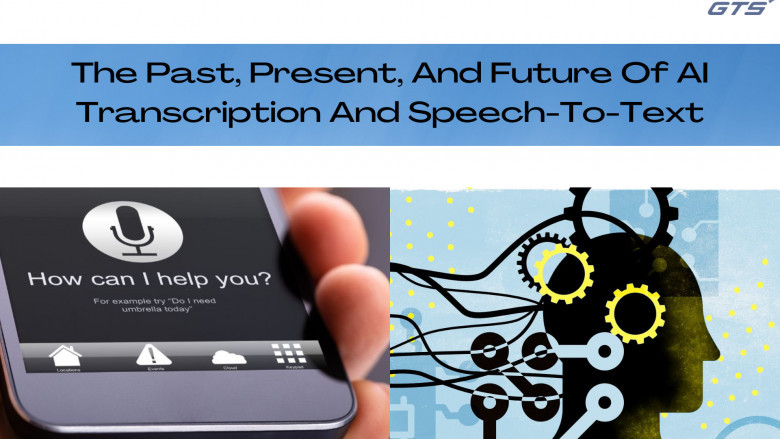
Audio transcription and AI speech-to-text are exploding with new applications and use cases. As artificial intelligence (AI) advances, new opportunities for speech-to-text conversion emerge daily. Software algorithms trained using powerful machine learning (ML) and natural language processing techniques are bringing us closer to a world where fully-digital transcribers will replace humans. However, when it comes to accuracy, AI is struggling to compete with humans. While much of the business is focused on full-scale automation, most speech-to-text use cases will require a human component for the foreseeable future to assure sufficient performance outputs. In this post, we'll look at the current state of speech-to-text AI and forecast the future trajectory of machine learning and natural language processing in this intriguing topic.
What exactly is AI Speech-to-Text?
AI speech-to-text is a branch of computer science that focuses on teaching computers to detect and transcribe spoken language. It is also known as automatic voice recognition, computer speech recognition, or speech recognition (ASR). Speech-to-text software differs from voice recognition in that it is trained to interpret and recognise the words uttered. Voice recognition software, on the other hand, concentrates on identifying individual voice patterns.
How Does Speech Recognition Work?
To function, speech recognition necessitates the use of highly trained algorithms, computer processors, and audio recording gear (microphones). The algorithms deconstruct the continuous, complicated Speech Datasets into discrete language components known as phonemes. A phoneme is the smallest unique unit of sound into which human language may be divided. Phonemes are the smallest units of sound that speakers of a language perceive as distinct enough to distinguish between words; for example, English speakers recognise "though" and "go" as distinct words because their first consonant sounds differ, although their vowel sounds are the same.
A language's phonemes may outnumber its letters or graphemes. Even though English only has 26 letters, certain dialects contain 44 separate phonemes. To make matters even more complicated, the acoustic qualities of a given phoneme vary based on the speaker and the context of the sound. In many dialects of English, the "l" sound at the end of the word "ball" is acoustically closer to the vowel sound "o" than it is to the "l" sound at the beginning of the word "loud." The algorithms that map acoustic data to phonemes must take context into account. The major steps in the AI speech-to-text pipeline are as follows:
- The mic records the noises that come from a person's mouth. Analogue signals are converted to digital data for the sounds.
- The software then examines the audio files bit by bit, down to hundredths/thousandths of a second, looking for known phonemes.
- The phonemes that have been detected are then processed through a database of popular words, phrases, and sentences.
- To generate the final text output, the software uses complex mathematical models to home in on the most likely words/phrases that match the audio datasets.
A Brief Overview of Speech Recognition
Bell Laboratories created the first voice recognition system in 1952. When its developer, HK David, voiced the sound of a spoken digit - zero to nine - it recognised it with more than 90% accuracy. IBM developed the "Shoebox" in 1962, a system capable of identifying 16 spoken English words. During the same decade, the Soviets developed an algorithm that could recognise over 200 words. All of this was based on previously recorded speech.
The next breakthrough occurred in the 1970s, as part of a Carnegie Mellon University effort supported by the US Department of Defence. The "Harpy," a device they created, could recognise complete sentences and had a repertoire of 1000 words. The vocabulary of speech recognition software had grown to 20,000 by the 1980s. Tangora was an IBM voice-activated typewriter that employed a statistical prediction model to identify words. The Dragon Dictate was the first consumer-grade text-to-speech tool, released in 1990. A successor, Dragon Naturally Speaking, was released in 1997 and is still used on many desktop computers today. Since then, text-to-speech technology has advanced by leaps and bounds, especially with the advent of high-speed internet and cloud computing. With its voice search and text-to-speech products, Google is the industry leader.
Current Applications of Speech-to-Text
Text-to-speech was once considered a specialised service. For data recording reasons, the primary consumers were businesses and government agencies/courts. Professionals such as doctors appreciated the service as well. Nowadays, anyone with a smartphone and an internet connection may use speech-to-text software. The demand for its features has also skyrocketed in the enterprise and consumer markets. The key sources of demand for AI speech-to-text can be broadly classified as follows:
1.Customer Support
- Many businesses use chatbots or AI assistants in customer service as a first layer to cut costs and improve customer experience. Because many users prefer audio chat, effective and accurate speech-to-text technologies can significantly improve the online customer care experience.
- For starters, AI chatbots with excellent speech recognition capabilities can relieve the burden on call centre management. As the first point of contact, they can determine the speaker's intent/need and direct them to the proper service or resource.
2.Content Search
- Again, the surge in smartphone usage is driving up demand for AI Speech Recognition Dataset algorithms. The number of prospective users has skyrocketed as a result of free speech-to-text services available on both the iOS and Android platforms.
- Humans vary greatly in terms of voice quality, speech patterns, accents, dialects, and other unique eccentricities. To produce satisfactory results, a competent speech-to-text AI must be able to recognise words and full phrases with decent accuracy.
- Smarter voice recognition systems will allow businesses to stand out from the pack. Modern users are famously demanding, with little tolerance for delays and poor service. Digital marketing has emerged as a primary driver of AI speech-to-text advancement, particularly on mobile devices.
3.Electronic Documentation
- There are many services and fields where live transcription is vital for documentation purposes. Doctors need it for faster, more efficient management of patient medical records and diagnosis notes.
- Court systems and government agencies can use the technology to reduce costs and improve efficiency in record keeping. Businesses can also use it during important meetings and conferences for the keeping of minutes and other special needs.
- The 2020 COVID-19 pandemic also revealed a new application for speech-to-text technology. Because of the large number of remote meetings and video conferences, firms can extract intelligence, summarise meetings, and derive analytics by recording talks using seamless speech-to-text technology.
4.Consumption of Content
- Global content accessibility is a major proponent of speech-to-text adoption. Digital subtitles are in high demand as online streaming replaces traditional sources of entertainment. Because information is transmitted around the world to viewers of various linguistic backgrounds, real-time captioning has a vast market.
- AI speech-to-text has enormous potential for usage in live entertainment, such as sports streaming. Commentary with real-time subtitles would be a game-changer in terms of accessibility and general user interest.
5.AI/ML/Role NLP's in Speech Recognition
- Artificial intelligence (AI), machine learning (ML), and natural language processing are three buzzwords intimately connected with modern voice recognition systems (NLP). These names are frequently used interchangeably, although they are not interchangeable.
- Artificial intelligence (AI) is a broad subject of computer science focused on creating "smarter" software that can solve problems in the same way that humans do. One of the primary purposes envisaged for AI is to aid humans, particularly in monotonous jobs. Computers equipped with speech-to-text software are not fatigued and can operate much faster than humans.
- Machine learning and AI are frequently used interchangeably, which is incorrect. Machine learning is an area of AI study that focuses on teaching computers/software to execute complex tasks such as transcription and speech-to-text by employing statistical modelling and massive volumes of relevant data.
- Natural language processing is an area of computer science and artificial intelligence that focuses on teaching computers to interpret human speech and text in the same way as people do. NLP is concerned with assisting machines in comprehending text, including its meaning, sentiment, and context. The idea is to use this information to interact with humans later on.
Text-to-speech basics Speech data is converted into text by AI. However, when it comes to advanced tasks like voice-based search and virtual assistants like Apple's Siri, NLP is critical for empowering the AI to analyse the data and produce accurate results that meet the user's needs.
The Future of Artificial Intelligence Transcription
With each passing year, our capabilities in deep learning neural networks grow, bringing us closer to wiser "hard AI." When it comes to detecting the intricacies buried in speech, computer algorithms are still not as sophisticated as humans at this point in technology. These places AI at a disadvantage in terms of accuracy. It's easy to find in the public domain - YouTube's automated captioning service is a good example. The results are quite accurate when the speaker uses native English with no strong accents. However, when specialised jargon, distinct speaking styles, and language diversity enter the picture, things start to go wrong. When high-quality, accurate transcriptions are required, humans are still required. However, for real-time speech-to-text, AI has all the advantages.
It is also substantially less expensive and more productive than humans, which are advantages inherent in practically all AI implementations. It will take years, if not decades, for the programme to achieve complete human speech understanding. We will continue to rely on human transcribers till then.
Conclusion
AI speech-to-text is currently in an interesting stage. With voice assistants, search, and controls becoming ubiquitous in modern life, there is a high demand for AI solutions that provide reliable results. That’s why we at Global Technology Solutions provide speech datasets, OCR Training Dataset and many more AI training dataset to train your AI and Ml models. Our services are highly reliable and we never compromise in our approach.


